Showing posts with label figure drawing. Show all posts

Saturday, December 7, 2013

Patterns, patterns everywhere!


Paul Klee
The last few months I've been working patterns.  Up until this time, I'd only played with patterns, done small ones, felt like they were insignificant and/or not completely worthwhile - I should be doing "real" art instead.  I don't know where I got the message that patterns aren't as important as realistic art.  There are many famous artists who have worked with patterns, some almost exclusively.  Paul Klee is a good example. He worked extensively to analyze color and shapes and patterns and taught those subjects at the Bauhaus School in Germany.  Lots of other artists have played with pattern as well including Mondrian and Gustav Klimt.  I have always been drawn to this type of work and have always created patterns and doodles of my own.  When my friend Linda Hollett told me about Zentangles a few years ago, I felt like I'd come home. 

The folks who created Zentangles describe them as the following:
The Zentangle Method is an easy-to-learn, relaxing, and fun way to create beautiful images by drawing structured patterns.

Almost anyone can use it to create beautiful images. It increases focus and creativity, provides artistic satisfaction along with an increased sense of personal well being. The Zentangle Method is enjoyed all over this world across a wide range of skills, interests and ages.
We believe that life is an art form and that our Zentangle Method is an elegant metaphor for deliberate artistry in life.
When I learned about them, I started filling 6"x9" notebooks full of my own Zentangles which I have started to call Zendoodles.  I teach classes about them at www.visarts.org as well as at my studio.  Here are a couple of my earlier ones...


 Recently I've been creating larger ones on 11"x14" Duralar, a type of translucent plastic paper that can be drawn on on both front and back.  Here are some of those...  (Sorry for the quality of the pictures.  I photographed them with my iPad and cropped them there, but the crop didn't transfer.)  These are done with Micron pens and color pencils which  glow beautifully on Duralar.
Ringdoodles


Figure Drawing 1st, Doodle 2nd


Flight of the Bumblebee


 I had such a wonderful time creating the Ringdoodles that I decided to create one that is much larger - 6'x10'!  I had a piece of canvas I'd put up on the wall several months ago.  I used it as a blow out piece and got all the mileage out of it I could so I decided to use it for this new piece.  I spent 10 hours working on it today.  (I've been busy with Beyond Barbie this week and with finishing up a commission the weeks before that and hadn't had much time to paint, so I've had a great time painting non-stop today!)

I don't consider this piece finished yet, but I made a lot of good progress today.  The background was already done.  I've just put in the rings today.
computer-generate image that stitched all my photos together.

detail
detail


detail


Saturday, August 25, 2012

My journey to vital gesture drawings

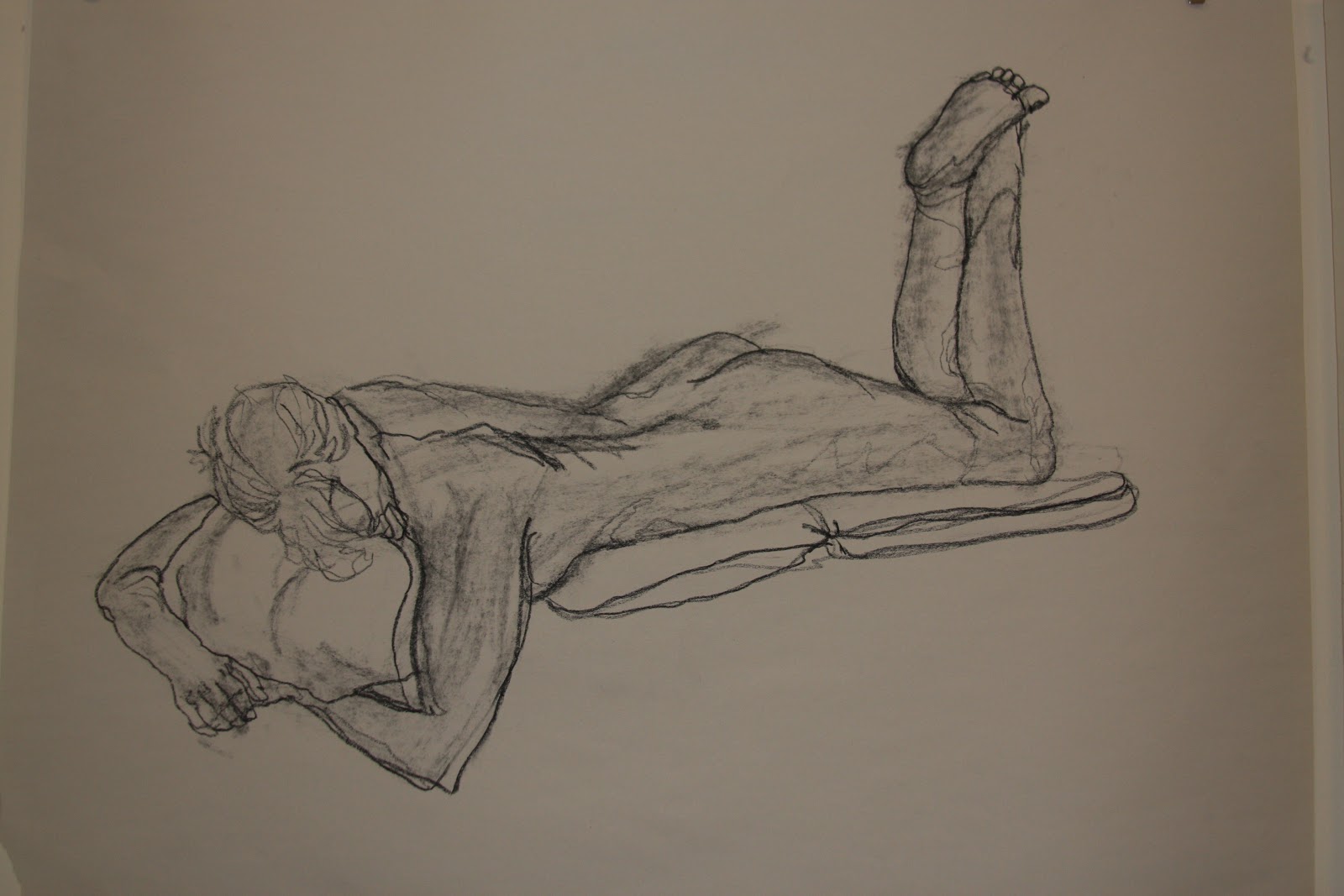
I had a breakthrough in figure drawing class, our last one, a couple of days ago.  We were doing gesture drawings at the beginning of class, as always.  I've become fairly pleased with how mine are starting to look.  When I first started class, they were pretty unskillful and I would come home feeling disappointed and frustrated.  I would watch Tommy draw his and could see how he got there, but I couldn't begin to draw something that pleased me aesthetically the way his did.  I didn't like my line.  Eventually, gradually, they began to develop, and I stopped feeling quite so constantly frustrated by them.  Here are some from 2 weeks ago.  Certainly you can tell what position the woman was in.  I don't think they're gorgeous, but they're not bad.

That same week, a few later, I decided to draw larger to see how that felt.  I wanted to stop restricting my movement, thinking that if I gave myself more space, I'd move more freely and the lines might get juicier.  This is the result of that.  I like it much better.

This past Wed, I was working on getting into the groove again, still drawing a bit small.  I first draw with a large piece of willow or vine charcoal to get the basic form of the figure, then I go back and draw contour lines around the figure.  In these I particularly liked the articulation of her calf in the one of the left and of her right elbow and shoulder (our left) on the figure on the right.  As I was drawing one of these, I overheard Tommy suggest to the student behind me that she draw the figure as if it's all one continuous piece of wire and she's sculpting it.  I know I'd heard him say that before, but this time it stuck and the picture below was the immediate result:
To me, these have a completely different feeling.  They might not be quite as accurate proportionally, but then again, perhaps they are.  One thing I know they are is more vital feeling to me.  I love the lines.  They remind me of some drawings I've seen by Matisse.  I don't mean to give myself an overabundance of praise - it's just that I like the lightness of line and the looseness I was able to achieve.  It's a huge breakthrough for me since before these I always felt so verklemmt, tight, rule-bound.  With these I finally found some joy and pleasure in exploring her image.  

new method next to old
The next one I did, I tried the same method.  She was sitting in a more complicated pose.  I started to get lost and unsure of myself so I drew it again using the method I'd used before.  Even though the new style looks a bit bizarre, I prefer it.  It simply has more vitality, in my opinion.  For the next two images, I decided to work on the whole page.  These made me happy.  I so enjoyed running the very sharp charcoal pencil point across the page, imagining myself actually touching the contours of her body as I went.  And I love the looseness and lightness of the image!  THIS is what I've been trying to do all these years since I first learned to do gesture drawings.  Now I can't wait to go to figure drawing tonight to practice some more!
Figure Drawing by Matisse

When we started working on the first 30 minute pose, I began it the same way - full page, large, light touch with the pencil.  The image was more complicated since she was holding a guitar.  I notice it came out almost life size and left out her legs completely.  I was trying to figure out what to do next but couldn't decide so I flipped the page and started over in the manner to which I am accustomed. That result is the more realistic looking image above.  I'm thankful I'm finally starting to get some skill so I can represent the models with some accuracy realistically.  I have a long way to go for them to look good, but at least they don't look quite as gallywampus as they did at first.  BUT what I notice is that I like the first one I did better.  It's more interesting, more full of life.  

For the next long pose, Tommy suggested I start loose again but this time push it a little bit and see where it goes, be willing to "ruin" a gesture drawing I like just to see what's on the other side.  Good advice.  I drew the gesture drawing light and loose with some distortions (unintended).  Tommy came over then and suggested I try to draw the way Sargeant did - stand back from the canvas to get some distance, look at the model carefully, then approach the canvas and place the mark in exactly the right place.  I was yearning for color, feeling like I could approach it much better with color, but having just white and black conte crayons along with vine charcoal and charcoal pencils restricted my choices and helped me learn all I could from what I had.  I tried to be mindful of each stroke and to place it carefully and exactly.  
I am very aware that her face looks weird, but it doesn't bother me.  I kind of like it, in fact.  And I like the overall piece.  It keeps me looking and more intrigued than does the above realistic one with the guitar.  I wrote about the experience of drawing this one on my blog from 8/24/12.  

I'm excited to have found a different way of approaching the models and my drawings of them.  I feel like I pushed through some fairly substantial resistance and came out the other side.  Tonight I'm going to Figure Drawing Session and will bring my pastels and some good paper so I can play with yet another way of approaching the drawings.  Experimentation is the life blood of art.  I'm becoming more and more grateful for this time away from pressure when I can take chances and can learn more about materials, methods, and myself.


Friday, August 24, 2012

The path to enlightenment is figure drawing

Each Friday I meet with a group of women to write.  Each week a different one of us is the leader who picks readings or artwork to prompt us to do the best writing we can.  This week Denise chose a poem by Billy Collins called Tension.

Suddenly, you were planting some yellow petunias
outside in the garden,
and suddenly I was in the study
looking up the word oligarchy for the thirty-seventh time.


When suddenly, without warning,
you planted the last petunia in the flat,
and I suddenly closed the dictionary
now that I was reminded of that vile form of governance.


A moment later, we found ourselves
standing suddenly in the kitchen
where you suddenly opened a can of cat food
and I just as suddenly watched you doing that.


I observed a window of leafy activity
and, beyond that, a bird perched on the edge
of the stone birdbath
when suddenly you announced you were leaving


to pick up a few things at the market
and I stunned you by impulsively
pointing out that we were getting low on butter
and another case of wine would not be a bad idea.


Who could tell what the next moment would hold?
Another drip from the faucet?
Another little spasm of the second hand?
Would the painting of a bowl of pears continue


to hang on the wall from that nail?
Would the heavy anthologies remain on their shelves?
Would the stove hold its position?
Suddenly, it was anyone's guess.


The sun rose ever higher.
The state capitals remained motionless on the wall map
when suddenly I found myself lying on a couch
where I closed my eyes and without any warning


began to picture the Andes, of all places,
and a path that led over the mountain to another country
with strange customs and eye-catching hats
suddenly fringed with little colorful, dangling balls.


From The Paris Review via Turk's Head Review.

We had ten minutes to write whatever we chose to in response to the poem.  Here's what I wrote:

Billy Collins' poem about the ordinariness of life became extraordinary the moment he added the word "suddenly" to it.  Then each action like opening a can of cat food took on a cosmic import.  Perhaps that is the way to enlightenment - to perceive everything, every single simple action, as sudden and surprising and noteworthy, even a lie-down on the sofa and a daydream about a land beyond the Andes.

How would it be if each stroke I drew were that noteworthy?  My teacher Tommy suggested I stand back from my two-minute gesture drawing we both liked with a fond attachment.  Stand back and contemplate with total attention the light landing upon her body, the shadows falling just so and defining her form.  Then, once I attained knowledge of the next right move, only then, approach the easel and carefully, mindfully, with absolute intent, place the mark I was meant to make.  Just so.

Then back off and contemplate her body again, the curved black armchair I've drawn scores of times now, the aqua-flowered pattern of her silk robe she sits upon, the perfection of her close-cropped boy-hair.  Notice the light and shadow on that spiky hair as it traverses her skull.  Trace the depth along her arm with my eye down my arm through the conte' crayon onto the newsprint.  Just so.

Suddenly?  In one way of looking at it, perhaps it is sudden, but to me several ice ages have come and gone while I observe and sense and monitor and express.  Each synapse is attended to as it transfers information about the bones beneath the skin of her knee from my eyes, through my brain, down my neck, into my arm, fingers, charcoal, all one - not sudden at all, a wagon train on the Conestoga Trail making its way at great peril to the ultimate goal of a new life.

Sunday, August 12, 2012

Figure Drawing Class

Six weeks ago I started taking a Figure Drawing Class with Tommy VanAuken at the Visual Arts Center here in Richmond.  That may sound odd since I've been drawing and painting the figure for several years now, but I'd never gotten good at drawing the figure from life, and I recognized it would be a great thing for me to do.

Last summer I took the same class with Lisa Johnson, also at the Visual Arts Center.  Lisa is a terrific teacher.  She analyzes the figure and teaches how many head lengths there are to the body and other proportions.  It's very helpful for figuring out precise placement of body parts.  It's also great for learning measuring and comparison skills.  I loved the class and planned to go to Figure Drawing sessions afterwards to continue practicing my skills.  Alas, I didn't.

So this year, feeling like my skills were rusty, I took Tommy VanAuken's class.  He has a completely different approach.  He teaches through gesture drawings.  Gesture drawings are VERY fast (between 15 seconds and 1 minute) representations of the ENTIRE - yes, the entire! - figure.  The point is to capture the essence of the movement.  It also has the incredible bonus of allowing the artist to capture proportions accurately without even trying.  If the eye is attuned to the figure and the hand is attached to what the eye is seeing, the proportions come out accurately, almost like magic.  There's a major skill to doing gesture drawings well, and I won't say I'm terrific at it, but I have improved dramatically over the course of the six weeks. 

The first ones I'm showing here are after about 3 weeks.  Tommy made us do about 40 gesture drawings with thick, fat vine charcoal in 15 seconds.  That was a great opportunity to stop thinking and to capture the essence.  These drawings were made first with the fat charcoal then I went and did some contour lines around the form.  We had a minute for each of these.

 These next drawings are from this past week.  Again I used the fat charcoal then a thinner charcoal pencil to get the contour.  I admit I am fascinated by how possible it is to capture so much in such a brief time. 

Chris, my husband, asked me the other day what it is about the figure that is so endlessly fascinating that people have been drawing it since time immemorial, and, more specifically, that I want to do it twice a week.  I had to think about that.  I think part of it is that it's a discrete object, unlike the landscape which contains so many zillions of objects that they can never all be comprehensively drawn.  The landscape overwhelms me.  Also, we know the human figure.  We know when we're on target, and we know when we aren't.  It's a constant challenge to draw it well.  And there is such beauty, such infinite beauty, in the human form.  The curves, the subtleties, the shadows, the light, the spark of soul. There are so many different forms the body can put itself into, and each person can do each of those (barring physical issues), so there is a never-ending assortment of positions to draw.  I haven't gotten bored yet. 

When I was painting from photographs, I also experienced the spark, the luminosity, the soul, but I got weary of copying from a grid.  I am excited to be trying to convey the beauty now from life. 


Here are a few pictures I drew 3 weeks ago in class.  The first two were 20 minute poses.

 
We had 40 minutes to capture this pose.  It's very helpful to have more time to shade the figure and to indicate the pillows she's resting on, etc.

 
Below is the picture I did last Friday.  There's a lot of foreshortening going on.  That means that part of her body is much closer to me, therefore larger, than other parts (her head, arms, etc.)  In order to draw it accurately, it's important to measure the different parts.  Otherwise, she will end up looking totally bizarre and out of proportion.  Foreshortening is one of the more difficult things to manage when drawing the figure (or anything else, for that matter).

Sunday, July 29, 2012

Left Brain Work, Right Brain Play

Last week I read a book which has impressed me greatly, My Stroke of Insight by Jill Bolte Taylor, PhD.  She is a neuroanatomist who, ironically, at age 37, had an aneurysm which caused the left side of her brain to be incapacitated.   Because she was so well versed in matters of the brain, she was able to figure out just what was happening to her and to call a friend before she lost consciousness so she could get help.   She observed her decline as it was happening.

This book was fascinating on many levels, but one of the things that stuck with me the most is her experience of having only the right brain functioning.  She described her experience as one of Nirvana as she understands it.  She had no sense of time.  She couldn't experience any differences between objects and/or people whom we normally perceive of as separate.  Everything she saw was simply matter/atoms/energy all blended together.  The only way she could tell the difference between things was if something moved.  She was almost unable to speak because her language center was in her left brain, as were her ego functions and all the parts of her brain which organized and schemed and figured things out.  Her "personality" was there (on the left side) as well.

She found life on the right side to be extremely compelling and she actually had to make a choice to work to regain functioning of the left side.  She did it so she could share with others that Nirvana is available to all of us all the time.

As she worked for 8 years to regain her left brain's functions, she noticed that when she got back some memories or some skills, they would be accompanied by certain feelings and perhaps even personality traits, some of which she found quite unpleasant.  She made a choice to regain the skills and memories but to leave the negative traits behind.  She learned that emotions come and go, lasting only 90 seconds.  She found that if she could simply ride the wave of an emotion such as anger, then it would pass, and she could discipline herself to not let it take over her consciousness.  She has three things she chooses to do instead to occupy her brain more positively.  I don't remember all three, but two of them are the following:  1) Think of something I am intrigued by and want to know more about.  2) Think of a sensual experience such as smelling baking chocolate chip cookies and focus on that.  In other words, she fills her brain with other things and lets the emotions pass.  I have been trying it since I read her suggestions and find it more helpful than not.  I have some work to do before I'm completely skillful at it, but I find it helpful to be so aware of my feelings and to recognize I have choices about what I do with them rather than letting them do what they want to with me.

The reason I'm writing about this book on my blog about my art is because it has helped me come to an awareness about how I've spent the last six weeks or so art-wise.  I've written about how I got great pleasure out of making a sketchbook and playing in it.  It is a completely different process from how I'm used to doing art.

I didn't go to art school, and I haven't had many skills-based art classes.  I got a MIS (Masters in Interdisciplinary Studies) in Art from VCU in 2003.  It consisted of being in class with professors who would give us individual support while we worked on our own projects.  (A couple of the classes were skills-based, like one on photo-transfers, but for the most part what I wrote was true.)  I enjoyed the support greatly and got a great deal out of it, BUT I didn't have a chance to learn skills like drawing and painting.  Ironic, right?  I think the (perfectly reasonable) assumption was that most people got those from their BFA degrees, but I don't have one.  I majored in German.  I am mostly self-taught as an artist, as far as skills go.

The way my brain works, I analyze things and figure them out.  I have a dominant left brain.  So when I wanted to figure out how to draw something, I - well - my first process would be too tedious to begin to describe!  Basically I did a proportion to figure out each significant point on a photographic image and placed that point in a corresponding place on the drawing.  It would take me untold hours to create a 3"x2" graphite drawing.  I got great satisfaction from doing it, and I loved how they turned out, but, my goodness!  They were time-consuming and, I recognize clearly now, very left brain centered.  Here's one of my first drawings done that way.  Yes, I figured out the placement of each of those blinds and shadows of blinds by using math and an exceedingly sharp pencil!

When I began working in pastels, I learned about how to use a grid.  My mother, who is also an artist, taught me a non-mathematical way to create a grid which I've used ever since.  It's much easier than finding the midpoint, then the midpoint of that, etc., etc.  To make things easier for myself, I created a grid like you see on the right in Adobe Photoshop and would superimpose it on the photograph I wanted to paint then would print it out that way.  Then I only had to draw the grid onto the canvas or paper, not also on the photo.

Here's an example of the beginning stages of gridding a piece of paper then transferring the image onto the paper from the photo using the grid to help:  (Phooey, the picture is being very weird - I can't get it to show up oriented correctly.  Sorry about that!  Hopefully you can get the idea anyway.)
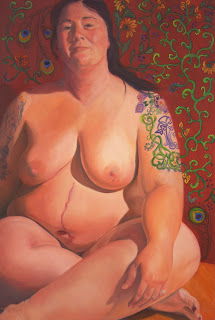
This is the process I used to create virtually all the pieces for Not Barbie.  It's a terrific way to get details correct and for me to make a person's face look accurate.  Of course, I can and do still make mistakes, but it's fairly simple really.  In fact, it's so simple that towards the end of preparing for the show, I think I was getting bored.  I'd put the piece on canvas then mix my paint then get ready to paint.  I'd get distracted.  I'd listed to a podcast while I was working.  I'd give myself a break to go get some food (I gained weight doing that!).  I'd write a blog - I was a very active blogger during this period!  What I didn't do, because I was on a deadline and because I knew how I wanted the pieces to look, was allow myself to play or experiment much at all.  Once I printed out the photo I was going to work from, I knew pretty much what the final piece would look like.  I like to think (and people have told me that appearances indicate this) that I put more than just mechanical skill into the paintings - I certainly felt a great deal of love and compassion for my models as I worked on each painting - but there was a great deal of mechanical work to do on each one.  For Scar Belly, for example, I gridded the tattoos on her arms so I could get them just right - I'd never painted a pattern like that before and wanted to get it just right.

The gift and pleasure I gave myself with that painting, though, was that I let the pattern of the tattoo extend off of her skin in a fantastical way.  I loved making the design, so I let myself play and continue it.  There are other examples of letting myself play, and those are the pieces, generally speaking, which I like the most.  For example, I took down an old canvas from my storage loft and painted "Dancing with Hotei" over top of it.  I love the juxtaposition of background and foreground in this and feel it is one of my more successful paintings.

The portrait I did of myself was over top of an oil painting as well, but all that shows through is the surface texture.  I did it in pastels.  That piece happened when I was feeling bored with my usual process.  I decided I had nothing to lose and would just do whatever the heck I felt like so I coated the lousy oil painting with glop I'd collected from my turpentine jar (paint from the brushes collects on the bottom of the jar after a while and can actually be re-used.  Not surprisingly, mine tends to be flesh-toned!  That's what I used.)  When that dried, I gridded the image onto the canvas then drew it in pastels.  To make the pastel stick to the very textured canvas, I used lots of fixative - something I otherwise never do because it changes the color and texture of the pastels - I hate the stuff!  But I had to use it here to make it work.  I decided to make that an element in the drawing.  The final piece is one of my best works, I think, partially because the texture is so intriguing.  (Detail shown here to show the texture.)

The point I'm making is that when I allowed myself to play, rather than just do the rote process, I got much more joy and pleasure out of it.  I was able to be more present.  I got out of my left brain, or at least accessed my right brain as well.

The last couple of months, working in my sketchbook, I've left my left brain outside the door almost completely and have given myself the chance to play and see what my right brain comes up with.  I also signed up for a figure drawing class.  I realize that seems odd since I've been working on figures since 2000, but as you just read, I gridded them.  I could paint anything on Earth with a grid, no matter how complicated, if I made it detailed enough.  I'm taking the class so I can learn to draw from life and to draw using my right brain.

It's a completely, utterly, totally different thing.  Completely.  It is much harder and more complex.  When I'm standing in front of the model with charcoal in hand, trying to render on paper what I see in front of me, every aspect of my being is engaged.  I hear nothing, I smell nothing, I feel nothing.  I have no concept of time.  I see only the model's figure and think only about how to render it accurately.  Line, form, value are on my mind.  Making it beautiful will come eventually, but right now I'm just hoping I can get a smattering of accuracy.  Here is an example of some of my 1 minute gesture drawings about 5 weeks after the start of the class.  I worry a bit that I'm "out-ing" myself and showing how unskillful I am, but I've decided that Beginner's Mind is the greatest gift I can give myself.  I have never learned how to do this.  Why should I expect myself to already be good at it?  It takes years of practice - even for the great artists!

So the work I'm doing now is I'm trying to allow my right brain access to my sketchbook and to my creative process.  It seems to be working.  I'm having a much more fulfilling time.  I'm relaxed and feeling tons of curiosity and pleasure.  I burnt myself doing the paintings purely mechanically.  My hope now is that I'll develop strong skills to draw from life and can take my art to a completely different level where I am free to experiment and play and can feel confident enough in my skills that I have the freedom to do all that.  It's great to have left brain skills - I don't mean to knock them - I'm very grateful to have them - I just want to enhance them greatly by adding creativity and curiosity and observational skills as well.

Have you ever gone through a similar process where you've done something almost exclusively from one side of your brain then worked to integrate the other side?  I'd love to hear about it if you have!

Friday, July 27, 2012

More meanderings through my sketchbook

The last few weeks I've continued working/playing/experimenting in my sketchbook.  It has been one of the most freeing periods of my artistic life.  I don't think I've ever before given myself such a stretch of time without goals or expectations to produce for a series or a show.  My perfectionism has, thankfully, taken a back seat, and my playfulness has come to the fore.

Here are some pictures I've done lately:


Street scene of Main St across the street from the Visual Arts Center.  Practicing one point perspective.  Pen and ink, watercolor, and graphite.

Pattern I more or less copied from a book about visual journaling.  Pen, ink, watercolor, watercolor pencils, wax crayons.

I gave my student the assignment of drawing an apple 10 times in 80 minutes.  I decided to do the same thing.  Until I got going - I couldn't let go of the prettiness of it and wanted to complete the drawing. I started in watercolor then my student wanted to use them so I had to move on - I switched to color pencil after that
After I finished the above apple, I went on to another one.  First I glued some random Dur-a-Lar to the paper just to give me some different textures to play with, then I painted it in acrylics.  I was fascinated to note how the paint acted on the Dur-a-Lar as compared to the regular drawing paper.  It resisted.  I used gold paint for the highlights on the apple.

Sometimes what I do in the sketchbook is affirmations or assertions.  I let myself be bold.  This was one of those times.


Zendoodles are never far away.  This one is Micron pens on Dur-a-Lar.


I use my sketchbook when I'm in figure drawing sessions on Friday evenings at the Visual Arts Center (all are welcome - $6/person - it's a great opportunity to draw from the model)  Sometimes my drawings aren't all that successful because I'm still learning to work from the figure from life.  The picture on the left is how it looked after 20 min.  then I brought it home and had a great time cutting up magazines and making it into something completely different.  Whether the pieces are skillful or not, I'm learning so much from doing them.  It is changing the way I approach art completely.

This is the same model.  I drew the gesture drawing with green Micron then put the body on it with a graphite pencil.  I used the scrap from a magazine to glue it into the sketchbook because glue doesn't seem to work too well on Dur-a-Lar.

A friend told me about this quote.  I thought it was worth noting:  "There's a crack in everything.  that's how the light gets in."  Leonard Cohen


Workin' my stuff.  And what a great place to do it.

This postcard was my place marker at my niece's wedding I went to lately.  Va Beach in the old days.

Another picture from figure drawing sessions.  I love how the white and black look on the red background.  This one made me happy.

21 things that didn't work that night when I was 16.
 
An earlier figure drawing session.  I drew the figure on Dur-a-Lar which is slightly see through - it's translucent - then did a pattern on the page behind it.  I'm intrigued by the juxtaposition of the two.

Allowing myself to play.  Zendoodles.  Colors.  Sumi ink, micron pen, watercolors, on rice paper.


As you can see, I'm not sticking to any one medium or paper or subject or type of creation.  Whatever arises is what gets expressed.  It's a very right brain way of approaching art.  I'll write more about the difference in my next post.  In the meantime, I'm enjoying these meanderings and am very curious to see where they're going...